Garmin Approach R10 Review (2026)
An in-depth Garmin Approach R10 review for 2026: radar accuracy, indoor space needs, simulator software, spin limits, and who the budget launch monitor really suits.
The Garmin Approach R10 is the budget radar launch monitor that made affordable home golf data real. At around $400 it delivers genuinely useful club head speed, ball speed, launch angle and distance numbers, pairs with a deep course library through the Garmin Golf app, and connects to third-party simulator software. Our verdict: for golfers who want reliable swing feedback and a simple home or range setup without spending four figures, the R10 is the easiest launch monitor to recommend, as long as you understand its honest limits on spin and its need for ball-flight room indoors.
Garmin Approach R10 and Two Alternatives
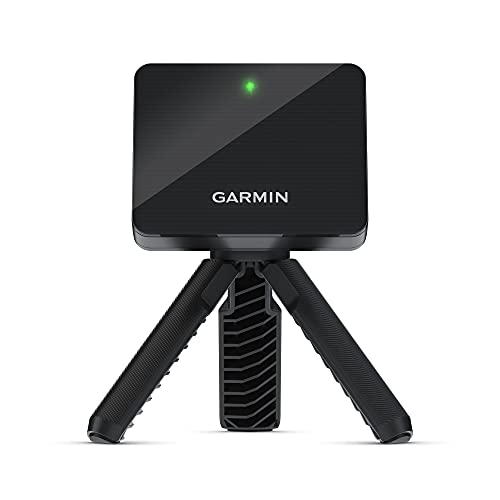
Garmin Approach R10 Portable Golf Launch Monitor
Doppler radar monitor tracking club head speed, ball speed, launch angle and estimated spin, with up to 10 hours of battery and IPX7 weather resistance.

Rapsodo MLM2PRO Launch Monitor
Radar-plus-dual-camera unit that adds measured spin and Impact Vision video, a natural step up if you want more data than the R10 estimates.

SkyTrak SkyTrak Launch Monitor and Simulator
Photometric camera unit that needs far less ball-flight room than radar, a better fit for short or shallow rooms where the R10 struggles.
The R10 is a Doppler radar unit, the same category as the FlightScope Mevo and the high-end Trackman, just at a fraction of the price. It sits behind the ball, tracks the launch, and feeds the data to your phone or PC. That radar design is the key to understanding both its strengths, real-world distance accuracy and easy outdoor range use, and its constraints, namely the depth it needs indoors and its estimated rather than measured spin.
Garmin Approach R10 at a glance
| Spec | Garmin Approach R10 |
|---|---|
| Technology | Doppler radar (ball-flight tracking) |
| Approx. price | Around $400 (list near $450) |
| Key metrics | Club head speed, ball speed, launch angle, smash factor, tempo, estimated spin |
| Stated accuracy | Club head speed approx. plus or minus 3 mph, ball speed approx. plus or minus 1 mph |
| Battery | Up to 10 hours |
| Weather rating | IPX7 |
| Simulator courses | 42,000+ via Garmin Golf app (subscription); E6 Connect and Awesome Golf supported |
Specs above come from Garmin's published figures. Treat the price as approximate, since Amazon pricing moves around the $400 mark.
Accuracy and the data it gives you
On the numbers it measures directly, the R10 punches well above its price. Ball speed and club head speed are consistent, which means carry distance and smash factor are trustworthy enough to track real progress club by club. Outdoors on a range, with full ball flight for the radar to read, the R10 is genuinely close to monitors costing several times more for those core figures.
The honest caveat is spin. The R10 estimates spin from the radar return rather than measuring it directly, so driver and long-iron spin tend to be reasonable while wedge and partial-shot spin can drift. If you obsess over short-game spin, this is where you feel the price difference. For most home golfers chasing tempo, speed and distance gaps, the data is plenty actionable. Our launch monitor comparison chart lays out how the R10's measured versus estimated metrics stack up against camera-based rivals.
Space it needs indoors
This is the single most important planning point. Radar units like the R10 sit behind the ball and need the ball to travel several feet before it hits your screen or net, so the monitor can read enough flight. Plan for roughly 8 feet or more between the ball and the impact surface, plus the depth for your own swing and a comfortable stance. Camera-based photometric monitors, by contrast, sit beside the ball and need far less depth.
Before you buy, run your real dimensions through our golf sim room size calculator to confirm you have the depth radar wants and the ceiling height for a full driver swing. If your room is short or shallow, a photometric unit like SkyTrak may simply fit better, which is why we included it as an alternative.
Who the R10 suits
- Golfers who want their first launch monitor without spending four figures.
- Range practicers who value portability, 10-hour battery, and IPX7 weather resistance.
- Home users with enough room depth to give radar proper ball flight.
- Players focused on speed, distance and consistency more than precise wedge spin.
It suits less well anyone with a tight, shallow room, or a data-obsessed player who needs measured spin on every wedge. Those golfers should look at the step-up and photometric options below.
Pros and cons
| Pros | Cons |
|---|---|
| Outstanding value near $400 | Spin is estimated, not measured |
| Reliable speed and distance data | Needs real ball-flight depth indoors |
| Portable, long battery, weather resistant | Full course library needs a subscription |
| Works with multiple simulator apps | Indoor realism depends on your PC and software |
Alternatives worth comparing
If you want measured spin and swing video, the Rapsodo MLM2PRO pairs radar with dual cameras for richer data around the $600 mark. If your room is short, the photometric SkyTrak sits beside the ball and needs much less depth. For a side-by-side breakdown, see our SkyTrak vs Garmin R10 comparison, and browse the full field in best launch monitors and best launch monitors under $1,000.
How we chose
We did not test the Garmin Approach R10 in person. This review is based on Garmin's published specifications and accuracy figures, the documented metric set and software compatibility, and patterns across verified owner reviews. We weighed the measured-versus-estimated data distinction heavily, since it is the most common point of confusion for buyers, and we cross-checked the indoor space requirement against general radar launch monitor behavior. Where we cite price, accuracy or battery figures, treat them as approximate manufacturer claims and confirm current details before purchase.
Buying tips
First, confirm your room. Radar needs depth, so check your space with the room size calculator before committing. Second, budget for software: the free Garmin Golf app covers data, but full virtual rounds or third-party simulators like E6 Connect carry subscriptions or licenses. Third, set expectations on spin, the R10 is excellent for speed, distance and consistency, and merely okay for precise wedge spin. Buy it for what it does well, and it is one of the best value tools in home golf.
Golf Sim Build Planner
Room-fit worksheet, gear checklist, budget tracker, and wiring and lighting plan, in one printable planner that takes your build from idea to first swing.
Frequently Asked Questions
Is the Garmin Approach R10 accurate enough for home practice?
For its price the R10 is impressively consistent on the metrics it measures directly. Garmin publishes club head speed accuracy of about plus or minus 3 mph and ball speed of about plus or minus 1 mph. Carry distance and launch direction track well outdoors. The weak spot is spin, which the R10 estimates rather than measures, so spin-sensitive shots like wedges can read off. For swing work and distance trends at home it is more than good enough.
How much room do I need to use the Garmin R10 indoors?
Because the R10 is a radar unit, it sits behind the ball and needs the ball to travel several feet before impact with a screen or net. Plan for roughly 8 feet or more between the ball and your impact screen, plus space for your full swing. Radar generally wants more depth than a camera-based monitor. Use our golf sim room size calculator to confirm your room can give the R10 the ball flight it needs to read shots cleanly.
Does the Garmin R10 work as a golf simulator?
Yes. Paired with the Garmin Golf app you can play virtual rounds on more than 42,000 courses with an active subscription, and the R10 also connects to third-party simulator software such as E6 Connect and Awesome Golf. Image quality and realism depend on the software you choose and the PC or device running it. The R10 supplies the shot data, while the simulator software handles the course graphics and play.
Does the Garmin R10 measure spin or estimate it?
The R10 estimates spin from radar data rather than measuring it directly with markers or cameras. For driver and longer clubs the estimate is usually reasonable, but on wedges and partial shots where spin matters most, the readings can drift. If accurate measured spin is a priority, a radar-plus-camera unit like the Rapsodo MLM2PRO or a photometric monitor like SkyTrak will give you truer spin numbers.
Garmin R10 vs SkyTrak: which should I buy?
Choose the R10 if you want the lowest price, portability, and outdoor range use, and you have the depth indoors for radar. Choose SkyTrak if your room is short or shallow, since photometric monitors sit beside the ball and need much less ball-flight room, and you want measured ball data. The R10 costs less and travels easily, while SkyTrak trades portability for tighter-room friendliness and simulator polish.
Do I need a subscription to use the Garmin R10?
Not for basic data. You can pair the R10 with the free Garmin Golf app to see club head speed, ball speed, launch angle, tempo and shot dispersion at no cost. The paid subscription unlocks features like home tee hero virtual rounds across the full course library and weekly tournaments. Third-party simulator software such as E6 Connect carries its own separate licensing, so factor that in if you want a full simulator experience.
Building a golf sim?
Use our free calculators and guides to size the room, the gear, and the budget.
Build Planner: $39